
HGHY Multi-Face Mold Punching Pulp Molding Machine — Quick Answer Summary
A multi-face mold punching pulp molding machine uses a continuously rotating drum fitted with multiple mold faces (typically 8 to 16). Each face passes through a pulp tank, forms a product under vacuum, then transfers it to the drying system — enabling much higher output than reciprocating or single-mold designs. HGHY's machines in this category are robot-free, using integrated mechanical transfer systems.
Products: egg trays, egg cartons, fruit trays, cup carriers, industrial packaging inserts, and molded fiber tableware (plates, bowls).
Key production stages: pulp preparation → vacuum forming on rotating multi-face drum → automatic product transfer → multi-layer metal conveyor drying → optional hot pressing → automated stacking and packing.
Capacity range: 3,000–7,000+ units per hour depending on drum configuration (8-face to 16-face) and product type. Main advantages over reciprocating machines: continuous forming cycle, higher throughput, lower labor per unit, more consistent product quality.
What Is a Multi-Face Mold Punching Pulp Molding Machine?
A multi-face mold punching pulp molding machine is a high-output pulp molding system built around a continuously rotating drum fitted with multiple mold faces — typically between 8 and 16, depending on the configuration. As the drum rotates, each face passes through a pulp tank where vacuum suction draws fiber onto the mold surface, forming a product. The formed product is then transferred automatically to the drying system, while the next face begins its forming cycle.
The key difference from a reciprocating (flip) machine is continuity. A reciprocating machine forms one batch of products, transfers them, then returns to form the next — an inherently stop-start process. A multi-face drum never stops. Every rotation produces a new batch of formed products from each face, which is why this machine type is the standard choice for manufacturers targeting high daily output volumes.
HGHY's multi-face mold punching machines are built around this principle, with the additional design advantage of robot-free product transfer — a development that simplifies the production line while maintaining the throughput that high-volume operations require.
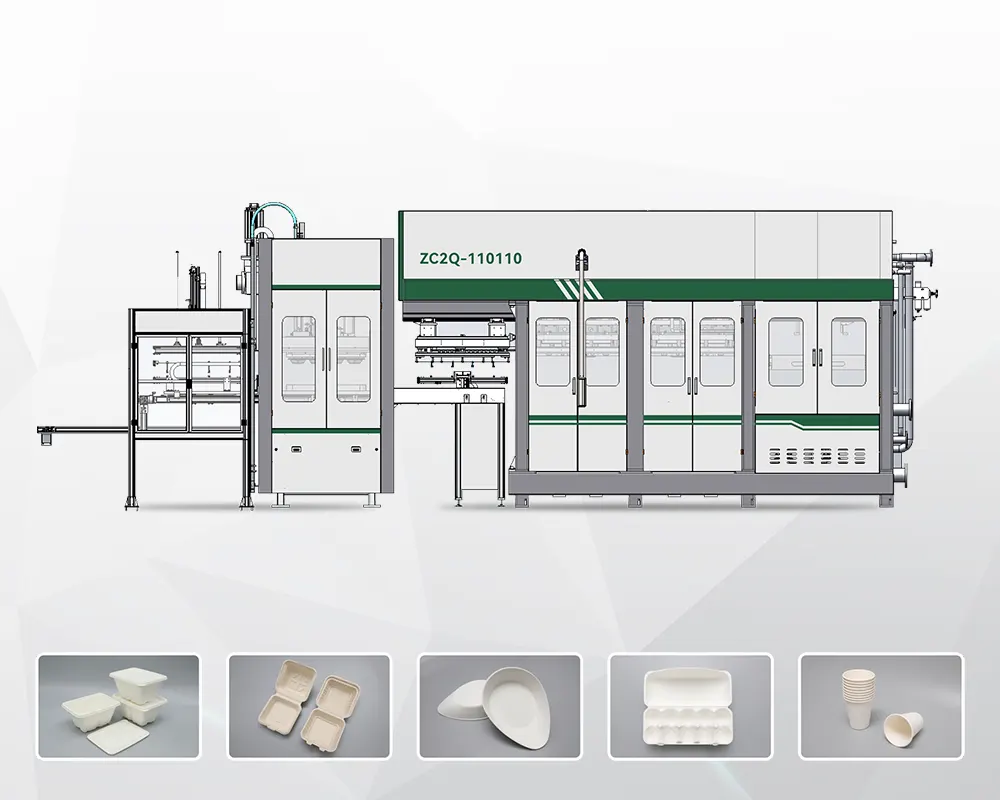 HGHY multi-face mold punching pulp molding machine — continuous rotary forming with integrated conveyor drying and automated stacking, no robots required.
View Product Details →
HGHY multi-face mold punching pulp molding machine — continuous rotary forming with integrated conveyor drying and automated stacking, no robots required.
View Product Details →
Continuous Forming
The rotating drum never stops — every face forms products on every rotation, delivering consistently high output with no cycle interruptions.
Robot-Free Operation
Integrated mechanical transfer systems replace industrial robots, lowering capital cost and reducing maintenance complexity without sacrificing output.
Flexible Mold Configuration
Available in 8-face to 16-face drum configurations. Molds can be changed to produce different product types on the same machine.
How It Works: The Continuous Forming Cycle
The operating principle of a multi-face mold machine is straightforward, but the engineering that makes it run reliably at speed is what distinguishes one manufacturer's equipment from another's. Here is how each stage works in an HGHY machine.
Pulp Preparation
Waste paper, recycled cardboard, sugarcane bagasse, or other fiber inputs are processed in a hydrapulper to produce a uniform slurry, typically at a concentration of 0.5%–1.5%. The pulp is screened, stored in agitated tanks, and fed continuously to the forming machine. Consistent pulp quality at this stage is a direct determinant of product strength and surface finish downstream.
Rotary Vacuum Forming
The multi-face drum rotates through a pulp tank. As each mold face submerges, a vacuum draws the fiber slurry onto the mold surface, building up a wet fiber layer in the shape of the product — egg tray, fruit tray, packaging insert, or tableware form. The vacuum is maintained long enough to achieve the target wall thickness, then the face rotates out of the tank carrying the wet-formed product.
Automatic Product Transfer
As the mold face reaches the transfer position, the formed product is released onto a drying carrier by reversing the vacuum to a positive air pulse. In HGHY's robot-free design, this transfer is handled entirely by the machine's integrated mechanical system — no robotic arm required. The precision of this transfer step is critical: products that shift or deform during transfer carry those defects through the rest of the line.
Multi-Layer Conveyor Drying
Wet products move through a multi-layer metal conveyor drying system where temperature, airflow, and belt speed are managed to reduce moisture content to below 12%. Multi-layer systems maximize drying capacity within a compact factory footprint — important for manufacturers optimizing floor space utilization on high-volume lines.
Hot Pressing (Optional)
For products requiring a smooth surface finish — retail egg cartons, premium food service items, or high-end industrial packaging — an inline hot press unit applies controlled heat and pressure after drying. This step compacts the fiber structure, eliminates surface roughness, and improves structural rigidity. It is standard for retail-grade output and optional for farm-supply or industrial applications.
Automated Counting, Stacking & Packing
Finished products are automatically counted, stacked to the specified bundle quantity, and prepared for dispatch. HGHY's integrated stacking systems handle this without manual intervention, maintaining the labor efficiency of the fully automated line through to the final output stage.
Mold Configuration and Capacity
The number of mold faces on the drum is the primary determinant of output capacity. More faces mean more forming cycles per drum rotation and more products per hour. HGHY offers multi-face mold machines in configurations from 8-face to 16-face drums, covering the full range of commercial production requirements.
The molds themselves — precision-machined in aluminum or copper — define the product shape and are designed for straightforward changeover when a line needs to switch between product types. A manufacturer running egg trays during peak agricultural season and switching to industrial packaging inserts during slower periods can do so by swapping the mold set rather than investing in an entirely separate line.
| Drum Configuration | Typical Output (units/hr) | Best Suited For | Drying System |
|---|---|---|---|
| 8-face drum | 3,000 – 4,500 | Medium-high volume egg tray, fruit tray, tableware | Metal conveyor (single or double layer) |
| 12-face drum | 4,500 – 6,000 | High-volume egg carton, industrial packaging | Multi-layer metal conveyor |
| 16-face drum | 6,000 – 7,500+ | Large-scale egg tray and carton production, export-volume operations | Multi-layer metal conveyor (extended) |
* Output figures are indicative for standard egg tray formats. Actual capacity varies by product geometry, pulp consistency, and drying configuration.
On a multi-face machine running at full speed, mold precision is amplified across every rotation. HGHY uses CNC-machined molds to ensure dimensional consistency across all faces — eliminating the variation that accumulates on lower-tolerance cast molds over a long production run.
Production Applications
The multi-face mold punching machine's combination of high output and flexible mold configuration makes it the preferred equipment choice across several product categories.
Egg Trays and Egg Cartons
This is where multi-face mold machines have the longest established track record. Large poultry farms, egg distribution networks, and packing houses require consistent supply at volumes that only a continuous rotary forming machine can deliver economically. HGHY's multi-face machines are used by egg producers supplying both domestic markets and export channels, where volume and dimensional consistency are non-negotiable requirements.
Fruit Trays and Agricultural Packaging
Apple trays, mango trays, avocado holders, and similar agricultural packaging formats are produced on the same multi-face platform with appropriate mold changes. The gentle cushioning properties of molded fiber make it the material of choice for protecting fresh produce through cold chain logistics, and HGHY's forming precision ensures consistent cavity depth and wall thickness across every tray in a production run.
Molded Fiber Tableware
Plates, bowls, and food service containers are increasingly in demand as plastic bans push food service operators toward compostable alternatives. Multi-face mold machines produce these items at the volumes that foodservice distributors and retail packaging suppliers require. With hot pressing inline, the surface finish of HGHY tableware output is competitive with premium plastic alternatives — a meaningful factor for brands concerned with product presentation.
Industrial Packaging Inserts
Electronics manufacturers, home appliance brands, and consumer goods companies sourcing molded fiber inserts to replace EPS foam need suppliers who can deliver at scale without dimensional variation. The continuous forming cycle of a multi-face machine — combined with HGHY's centralized process monitoring — produces inserts with the consistency these customers require across large order volumes.
Robot-Free Design: A Practical Advantage
One of the more significant engineering decisions in HGHY's current multi-face mold machines is the elimination of industrial robots from the production line entirely. Earlier generations of high-output pulp molding equipment used robotic handling systems to transfer products between the forming drum, drying conveyor, hot press, and stacking stages. HGHY's redesigned lines accomplish all of these transfers through integrated mechanical systems.
The practical implications are meaningful. Robotic systems add to the capital cost of a line, require programming expertise that many manufacturing facilities do not have in-house, and introduce failure modes — sensor errors, calibration drift, mechanical faults — that can stop an entire production line. By removing robots from the design, HGHY has reduced the number of systems that operators need to monitor and maintain, and lowered the bar for the technical expertise required to run the equipment reliably.
For manufacturers in markets where specialist robotics maintenance is expensive or hard to source, this design choice has a direct effect on uptime and total cost of ownership over the machine's operational life. The output numbers are the same — or better — without the added operational complexity.
Fewer moving systems means fewer points of failure. HGHY's robot-free multi-face mold machines are designed to be maintained by production floor technicians without specialist robotics training — an advantage that compounds over years of continuous operation.
Consistency at High Speed
Running a multi-face mold machine at full capacity means producing thousands of units per hour — and every one of those units needs to meet the same dimensional and quality standard. That is not a given. At high forming speeds, small variations in pulp concentration, vacuum pressure, mold temperature, or drying conditions can translate into product defects that propagate across an entire shift before they are noticed.
HGHY addresses this through centralized process monitoring across all critical parameters. Forming vacuum, pulp feed rate, mold temperature, drying conditions, and moisture content at the output stage are tracked continuously, and operators can respond to deviations in real time rather than discovering a quality problem in the finished stack. For manufacturers supplying customers with strict incoming inspection requirements — large supermarket chains, export markets, electronics OEMs — that level of process control is what makes a reliable supply relationship possible.
| Parameter | HGHY Control Method | Impact on Product Quality |
|---|---|---|
| Pulp concentration | Agitated holding tanks, continuous feed monitoring | Wall thickness consistency, structural strength |
| Vacuum forming pressure | Centralized vacuum system, real-time pressure monitoring | Forming completeness, cavity definition |
| Drying temperature and airflow | Automated conveyor speed and temperature control | Moisture content, dimensional stability |
| Hot press temperature | Servo-controlled press with temperature feedback | Surface finish, structural rigidity |
| Transfer precision | Integrated mechanical transfer — no robot variables | Product geometry maintained through line |
Multi-Face Mold vs. Reciprocating Machines
The choice between a multi-face rotary machine and a reciprocating machine is fundamentally a question of scale. Both produce quality molded fiber products, but they are designed for different production volumes and investment levels.
Reciprocating machines are well suited to small and medium operations — new businesses entering the molded fiber market, facilities producing a limited daily volume, or manufacturers that need flexibility to run short product changeovers frequently. Their lower initial cost and simpler mechanical design make them accessible to a wider range of buyers.
Multi-face mold machines are the right choice when volume is the primary requirement. The continuous forming cycle means more output per shift, lower labor cost per unit, and better utilization of the drying and pressing systems downstream. For a manufacturer supplying a large egg distributor, a national supermarket chain, or an electronics OEM at scale, the economics of a multi-face machine are substantially better over the operational lifetime of the line.
| Factor | Multi-Face Mold Machine | Reciprocating Machine |
|---|---|---|
| Forming cycle | Continuous rotation — no stops | Reciprocating — stop-start cycle |
| Output capacity | 3,000 – 7,500+ units/hr | 500 – 2,500 units/hr |
| Labor per unit | Lower — fully automated transfer and stacking | Higher — more manual intervention at lower scales |
| Initial investment | Higher | Lower |
| Best for | High-volume continuous production | Small-medium volume, flexible changeovers |
| Robot dependency | None (HGHY robot-free design) | None at basic level; optional at higher automation |
Energy Efficiency
A multi-face mold machine running at full capacity consumes energy continuously — forming, drying, and pressing without pause. Over the course of a year of operation, energy costs represent a significant portion of total production cost, and the efficiency of the drying system in particular has a direct effect on the line's economics.
HGHY's multi-layer metal conveyor drying systems are designed with this in mind. Heat recovery systems capture and recirculate thermal energy within the drying tunnel, reducing the fuel or electrical input required per unit of output. Automated airflow and temperature control prevent energy waste from over-drying or uneven temperature distribution across the conveyor width — a common inefficiency in less precisely controlled systems.
Servo-controlled forming systems also contribute to energy efficiency at the forming stage, matching motor output to actual load demand rather than running at fixed power regardless of conditions. Across a production line operating 16 to 24 hours per day, these design choices accumulate into meaningful reductions in energy cost per thousand units produced.
For manufacturers competing on price in commodity markets like egg trays or standard tableware, energy cost per unit is a genuine competitive differentiator. HGHY's drying and forming efficiency improvements are not just environmental credentials — they are margin points that compound over the operational life of the line.
Frequently Asked Questions
A multi-face mold punching pulp molding machine uses a continuously rotating drum fitted with multiple mold faces — typically 8 to 16. Each face passes through a pulp tank, forms a product under vacuum, and transfers it to the drying system on every rotation. This continuous cycle produces significantly higher output than reciprocating machine designs, making it the standard choice for high-volume molded fiber production.
HGHY multi-face mold machines can produce egg trays, egg cartons, fruit trays, cup carriers, industrial packaging inserts, and molded fiber tableware including plates and bowls. Product type is determined by the mold set installed on the drum, which can be changed to switch between product formats.
HGHY multi-face mold machines are available in 8-face, 12-face, and 16-face drum configurations. More faces produce more output per rotation. The right configuration depends on target daily capacity, available floor space, and the drying system selected.
No. HGHY's latest multi-face mold punching machines are designed without industrial robots. Product transfer between forming, drying, and stacking stages is handled by integrated mechanical systems, reducing capital cost, simplifying maintenance, and eliminating the failure points associated with robotic handling.
Output typically ranges from 3,000 units per hour for an 8-face configuration to 7,500+ units per hour for a 16-face machine, based on standard egg tray formats. Actual capacity varies by product geometry, pulp consistency, and drying system configuration. HGHY can provide capacity estimates based on your specific product and raw material requirements.
Choose a multi-face mold machine when high daily output volume is the primary requirement and the economics justify the higher initial investment. Reciprocating machines are better suited to smaller operations, new market entrants, or facilities that need frequent product changeovers. For manufacturers supplying large distributors, supermarket chains, or industrial customers at scale, the lower cost per unit of a multi-face machine makes it the more economical choice over the life of the line.