
Green manufacturing · Global investment
Automatic fiber plate forming line: the complete guide for global investors (2026)
What an automatic fiber plate forming line actually is
An automatic fiber plate forming line is an integrated manufacturing system that converts recycled paper pulp, sugarcane bagasse, bamboo fiber, or wheat straw into finished molded fiber tableware — plates, bowls, and trays — through a continuous, largely unmanned process. A full production line runs on four systems working in sequence: pulping, vacuum forming, thermal drying, and automatic packing. Only the mold geometry and wall-thickness profile change between product types.
Worth flagging early: the same core equipment logic that applies to fiber plates also covers food trays, coffee cup lids, and industrial cushioning inserts. Knowing this matters when talking to a supplier — otherwise you may get quoted for a stripped-down configuration that can't flex across product categories as your customer mix evolves.
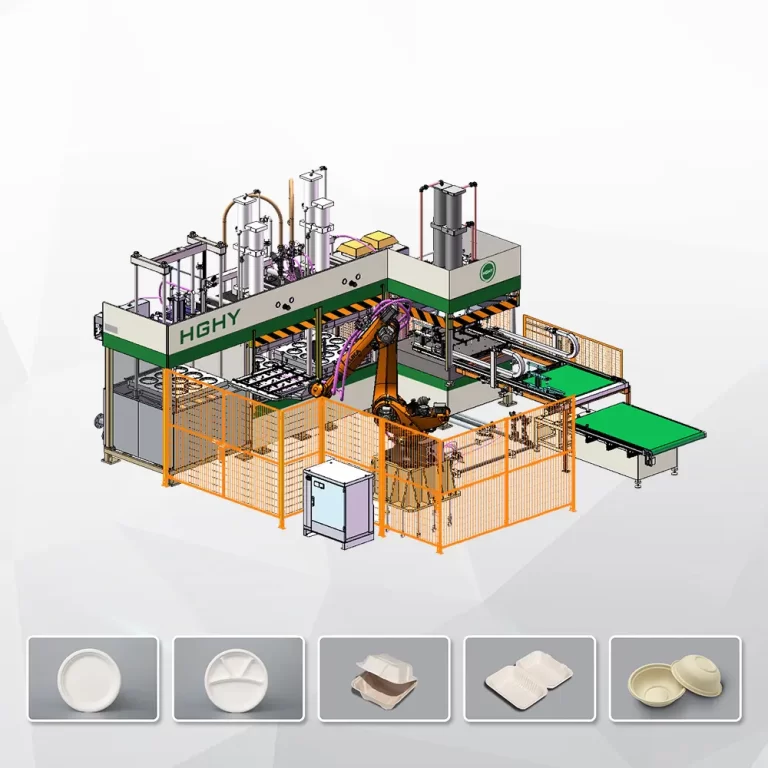 HGHY Pulp Molded Tableware Machine — fully automatic fiber plate forming line with multi-layer drying and auto-packing, available in multiple capacity configurations.
View product details →
HGHY Pulp Molded Tableware Machine — fully automatic fiber plate forming line with multi-layer drying and auto-packing, available in multiple capacity configurations.
View product details →
From waste fiber to finished plate: the process, step by step
The chemistry behind molded pulp isn't complicated, but how tightly each stage is controlled determines the final strength, finish, and energy bill.
- 1 Pulping. Recovered paper, agricultural residue, or bamboo fiber gets pulverized, screened, and blended with additives to produce pulp at the concentration needed for forming. The raw-material bar is genuinely low — most lines run on a fairly dilute pulp mix, which is why factories typically source scrap from nearby paper recyclers, printing plants, or sugarcane processing facilities rather than buying virgin pulp.
- 2 Vacuum forming. This is the heart of the process. A vacuum pump system pulls pulp tightly onto a rotating mold, drawing off part of the moisture simultaneously. An air compressor then separates the wet-formed plate from the mold, a conveyor carries it to drying, and a cleaning unit resets the mold for the next cycle. The density and dwell time of the suction holes determine whether every plate ends up with even wall thickness — which is why two lines both marketed as "fully automatic" can produce plates with noticeably different strength and surface finish.
- 3 Dewatering. Right after demolding, the wet plate still holds significant moisture. Mechanical pressing removes most of that before the plate enters the dryer. Outsiders tend to overlook this step, even though skipping it just shifts the energy cost downstream onto the drying tunnel.
- 4 Thermal drying. This stage sets both the real production ceiling and the running-cost profile. Natural air drying depends on local weather and typically takes 4–7 hours; switching to a multi-layer metal drying tunnel cuts that to 10–25 minutes. For any plant running several thousand pieces a day, open-air drying isn't viable — it eats floor space and can't keep pace with order volume.
- 5 Counting and packing. Dried plates pass through an automatic counter and packer that compresses and bundles them to a set count, cutting storage space and transit breakage.
Capacity tiers and what automation actually costs you
This is where most buyers focus most attention — and where spec sheets are easiest to misread. Two lines can both carry the "fully automatic" label while sitting on completely different scales of investment, floor space, and labor dependency.
- Small-scale lines: typically 1,000–2,500 pieces per hour. A 4×4 configuration on roughly 3 kW is a reasonable entry point for limited budgets, though labor dependency stays high.
- Semi-automatic rotary lines: 8-face rotary machines can reach 3,500–4,500 pieces per hour. Drying on this tier often still relies on manual intervention or open-air drying.
- Fully automatic mid-to-large lines: a 5×12 model can reach 5,000–6,000 pieces per hour with a high degree of automation, sharply cutting manual handling from raw material to finished product. These lines usually include multi-layer metal drying and automatic packing as standard.
- Large-scale lines: an 8×8 configuration with 64 molds can reach 9,000–10,000 pieces per hour — the current ceiling for single-line capacity, suited to export-oriented factories or large institutional buyers.
The more useful question to ask a supplier isn't "is this fully automatic" — it's: is drying done by open air, brick tunnel, or multi-layer metal line, and is packing automatically counted and compressed? Those two answers tell you far more about real labor cost and output consistency than any label does.
The plastic ban tailwind: a structural demand driver
The global push to eliminate single-use plastics is no longer a trend — it is regulatory infrastructure. The European Union's Single-Use Plastics Directive banned disposable plastic plates and cutlery across all 27 member states. The UK, Canada, Australia, India, China, and dozens of developing nations have enacted parallel legislation. Violations now carry fines that make plastic supply chains economically untenable for food-service operators in a growing number of markets.
This legislative pressure has created a structural demand shock for fiber-based alternatives. Restaurants, airlines, event caterers, institutional food services, and e-commerce fresh-food brands must replace plastic inventory — creating immediate and recurring demand for molded fiber plates and trays. Investors who secure production capacity now benefit from first-mover pricing power in local markets still experiencing supply deficits.
Environmental credentials and ESG alignment
Fiber plate manufacturing carries a strong lifecycle environmental profile. The carbon footprint of a molded fiber plate is estimated at 60–80% lower than an equivalent polystyrene plate across its full lifecycle. Water used in the wet-forming process is typically recycled in a closed loop, and the energy intensity of modern hot-press dryers has fallen with heat-recovery technology.
For investors seeking green-finance instruments, fiber plate production facilities frequently qualify for green bonds, climate-linked loans, and IFC or ADB sustainability financing — lowering the effective cost of capital by 50–150 basis points relative to conventional manufacturing projects. Scope 3 emission reductions from switching food-service supply chains from plastic to molded fiber have been quantified at 1.2–2.4 kg CO₂e per 100 plates, creating verifiable carbon credit value for producers operating in voluntary carbon markets.
Global market opportunity by region
Asia-Pacific
Asia-Pacific represents both the largest manufacturing base and a rapidly growing end-market. China's plastic ban policies since 2021 have stimulated a wave of new fiber plate capacity, but domestic demand — especially in food delivery — continues to outstrip supply. India, Vietnam, Thailand, and Indonesia present greenfield opportunities where plastic bans have been enacted but local fiber production remains underdeveloped.
Europe and the Middle East
European markets demand premium product quality: tight dimensional tolerances, PFAS-free coatings, and certified compostability under EN 13432 or DIN CERTCO standards. Investors targeting European buyers must ensure their automatic line produces fiber plates that meet these certification thresholds. The Middle East — particularly the UAE and Saudi Arabia — is a fast-growing import market where large hospitality and events sectors require consistent fiber plate supply.
North America
California, New York, and Washington have enacted the most comprehensive single-use plastic restrictions in the US, with similar legislation advancing in 18 additional states. Food-service distributors are actively contracting 3–5 year supply agreements to lock in compliant fiber tableware — creating long-term revenue visibility for new plants.
What to verify before you buy
After all the specs and market numbers, a few details get overlooked far too often during procurement — and they're the ones that cause real problems later.
- How many molds come standard, and how compatible they are. Molds are consumable — wear degrades forming precision over time. Ask suppliers directly about expected mold lifespan and replacement cost per set, rather than judging the deal purely on the price of the main machine.
- Whether the drying system genuinely matches stated capacity. Open-air drying and a metal drying tunnel can differ by tenfold in cycle time, yet some suppliers quote a stripped-down setup to keep the headline price competitive. Plants often discover only after startup that drying can't keep pace with forming.
- Whether local energy infrastructure supports the line's designed heat source. Drying lines commonly run on natural gas, diesel, biomass pellets, or steam from heat-conducting oil. If natural gas supply is inconsistent locally but the equipment is designed around gas-fired drying, retrofitting later tends to cost more than expected.
- After-sales support and parts turnaround. Core wear parts — molds, seals, vacuum pump components — need replacing fairly often. For cross-border purchases especially, confirm where spare parts are stocked and how fast they can be shipped; downtime waiting on parts can cost more than the equipment's own depreciation.
The process engineering behind a fiber plate forming line is mature and well understood. What determines return on investment usually isn't the "automatic" label on the spec sheet — it's the real efficiency of the drying system, how long the molds last, and whether the supplier's after-sales support holds up after the line is installed.
Frequently asked questions
What raw materials can be used in a fiber plate forming line?
The most common feedstocks are sugarcane bagasse, recycled newspaper or cardboard pulp, bamboo fiber, wheat straw, and reed pulp. Bagasse is preferred in tropical regions for its low cost and availability. The forming line's mold tooling and pulp concentration system must be matched to the chosen feedstock.
What is the production capacity of a full automatic fiber plate line?
A standard automatic line produces between 3,000 and 8,000 plates per hour depending on plate size and configuration. A facility running two shifts on a four-station line can realistically achieve 40–60 million pieces per year — sufficient to supply a mid-sized regional distribution network.
How does the plastic ban affect demand for fiber plates specifically?
Single-use plastic plates are among the most directly targeted items in global plastic ban legislation. Unlike some biodegradable alternatives such as PLA, molded fiber plates are accepted under virtually all regulatory regimes without requiring industrial composting infrastructure, making them the lowest-friction compliance option for food-service businesses worldwide.
What certifications are needed to export fiber plates to Europe or the US?
For European markets, EN 13432 compostability certification and a PFAS-free material declaration are increasingly mandatory. For the US food-service channel, FDA 21 CFR food contact compliance is required. Many retail buyers additionally require FSC chain-of-custody certification on fiber inputs, and producers targeting premium retail should also consider DIN CERTCO or TÜV Austria OK Compost certification.
Is fiber plate manufacturing eligible for green financing?
Yes. Projects producing certified compostable or biodegradable fiber tableware typically qualify under green bond frameworks aligned with ICMA Green Bond Principles, and under sustainable finance frameworks of multilateral development banks including the IFC and ADB. Some jurisdictions also offer concessional loans or tax incentives for plastic-substitute manufacturing investments.
How long does it take to recoup the investment in a full automatic line?
Payback periods typically range from 18 to 24 months for well-located plants with anchor customer contracts in place. Plants entering markets still experiencing supply deficits — particularly in Southeast Asia, South Asia, and the Middle East — have in several cases reported payback inside 14 months. The drying configuration and off-take security are the two variables with the most influence on actual ROI.
Market projections referenced in this article draw on publicly available research from the UN Environment Programme, IFC sustainable finance frameworks, and industry analyst forecasts current as of Q2 2026. Individual investment outcomes depend on local energy costs, regulatory environment, and sales channel configuration.