
Molded Pulp Protective Inserts Machine — Quick Answer Summary
A molded pulp protective inserts machine converts recycled fiber (waste paper, cardboard, bagasse, bamboo) into custom-shaped protective packaging inserts. A complete line integrates four stages: pulping, vacuum forming, drying, and hot-press finishing. The output replaces foam and plastic packaging in electronics, industrial, cosmetics, and pharmaceutical sectors.
Two core forming types: wet press (blank transferred directly to heated mold, cycle under 10 seconds, smooth single side) and dry press/thermoforming (oven-dried then hot-pressed, tighter tolerances, smooth both sides). Commercial line capacity: typically 650–800 kg per day. Hot press temperatures: 150–220°C. Setup lead time: approximately 130 days from order to first production run.
Market: global molded pulp packaging valued at USD 5.78 billion in 2025, projected USD 11.01 billion by 2034 (CAGR 7.52%). Electronics application growing at 7.5% CAGR. Asia Pacific holds 46.79% of global volume.
What Is a Molded Pulp Protective Inserts Machine?
A molded pulp protective inserts machine is specialized industrial equipment that converts recycled fiber — waste paper, cardboard, sugarcane bagasse, bamboo — into custom-shaped protective packaging. The output replaces foam, plastic blister packs, and corrugated inserts across a wide range of industries.
The machine doesn't simply press pulp into shapes. A complete production line integrates four distinct processes: pulping (breaking down raw fiber into a water slurry), vacuum forming (shaping the slurry over molds using suction), drying (removing moisture via oven tunnels or hot-press plates), and finishing (optional hot-pressing, trimming, and quality inspection). Each stage directly affects the structural integrity, surface finish, and dimensional accuracy of the final insert.
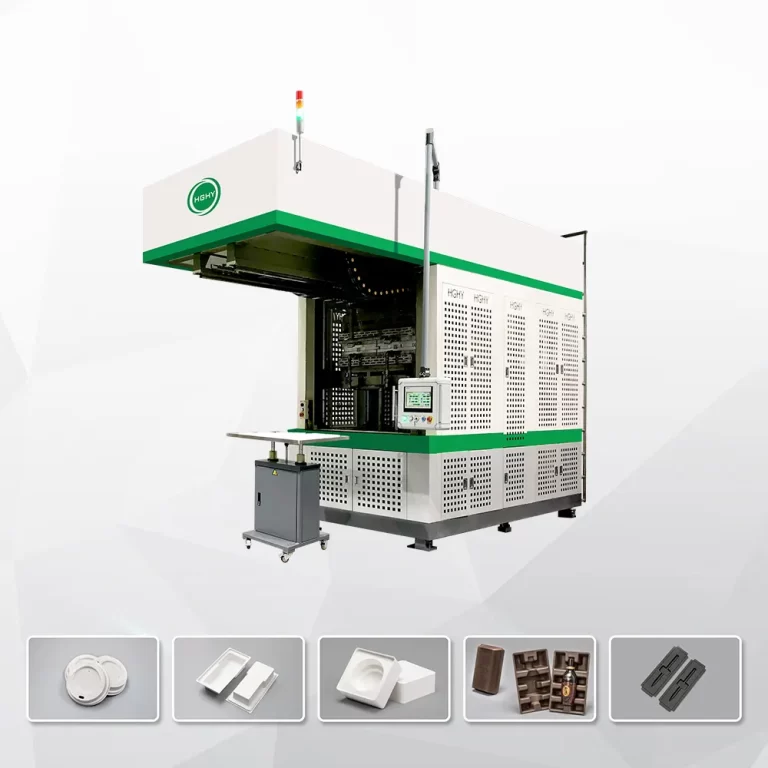 HGHY Packing Tray Making Machine (Model ZJWD-9575) — reciprocating thermoforming with integrated hot pressing, trimming, and stacking. Platen size 950 × 750 mm, max pressure 55 tons. Suited for mobile phone linings, cosmetic packaging, and precision 3C digital product inserts.
View Product Details →
HGHY Packing Tray Making Machine (Model ZJWD-9575) — reciprocating thermoforming with integrated hot pressing, trimming, and stacking. Platen size 950 × 750 mm, max pressure 55 tons. Suited for mobile phone linings, cosmetic packaging, and precision 3C digital product inserts.
View Product Details →
100% Recycled Fiber Input
Processes waste paper, OCC cardboard, bagasse, and bamboo into biodegradable, compostable inserts — raw material costs are not tied to petroleum pricing.
Vacuum Forming Core
Fiber slurry is drawn onto wire-mesh molds by vacuum suction. Mold geometry determines every cavity, rib, and nesting feature in the finished insert.
Integrated Production Line
Pulping, forming, drying, and hot-pressing are handled in a single integrated line — from bulk raw material to palletized finished insert.
Why This Market Is Growing So Fast
The numbers behind this industry are difficult to dismiss. The global molded pulp packaging market was valued at USD 5.78 billion in 2025 and is projected to reach USD 11.01 billion by 2034, expanding at a CAGR of 7.52% over the forecast period. Asia Pacific currently holds the dominant share at 46.79% of global volume (Fortune Business Insights, 2025).
Several forces are converging simultaneously. Governments across Europe, Asia, and North America are tightening restrictions on single-use plastics — the UK's Plastic Packaging Tax and the EU's Packaging and Packaging Waste Regulation are accelerating corporate shifts toward fiber-based alternatives. In December 2024, UNIDO released a comprehensive policy report highlighting molded fiber pulp as a critical substitute for conventional plastics within circular economy frameworks.
The electronics segment is forecast to grow at a CAGR of 7.5% through the early 2030s, driven by demand for precision-fit inserts that protect sensitive components during global shipping. Samsung's publicly documented decision to use 100% recycled molded pulp trays for the Galaxy S24 is a marker of this shift — when tier-one brands commit, their supply chains follow. Meanwhile, rapid e-commerce expansion is increasing demand for protective packaging that can absorb impact, wick moisture, and stack efficiently in fulfillment centers.
Wet Press vs. Dry Press: The Core Choice
The most consequential decision when selecting a molded pulp insert machine is the forming method. Wet press and dry press produce meaningfully different products and suit different application requirements.
Wet Press Forming
- Wet blank transferred directly to heated mold pair
- Simultaneous compression and drying
- Full cycle typically under 10 seconds
- Smooth finish on press side; lightly textured on reverse
- Suited for lightweight products, cosmetics, pharma inserts
- Lower energy consumption per cycle
Dry Press / Thermoforming Electronics Standard
- Wet blank oven-dried before secondary hot-pressing
- Higher pressure produces denser, stiffer insert
- Tighter dimensional tolerances
- Smooth finish on both surfaces
- Standard for e-commerce electronics and industrial components
- Higher energy use and longer cycle time
If the insert will hold a consumer device inside a retail box and be the first thing a customer sees when opening, dry press thermoforming is the expected standard — the surface quality is noticeably different. For industrial shipping inserts where surface aesthetics are secondary to cushioning performance and cost, wet press is typically sufficient. Mixed-application facilities sometimes run both methods on separate lines or configure a hybrid line with both drying stages available.
How the Forming Process Works: Step by Step
Understanding the mechanics allows you to evaluate any machine specification or supplier claim against what actually happens on the production floor.
Pulp Preparation
Raw material is shredded and mixed with water at a ratio of roughly 1–2% fiber to 98–99% water. Non-fiber contaminants — staples, adhesives, coatings — are screened out. The resulting slurry is held in a pulp chest and pumped to the forming station on demand. Fiber blend adjustments (adding OCC for stiffness, or bagasse for moisture resistance) are made at this stage.
Vacuum Forming
A forming mold — wire mesh over a metal frame — is submerged in or flooded with slurry. Vacuum draws fiber onto the mesh surface, building up a wet blank of uniform thickness. Mold geometry determines the final insert shape: cavities, ribs, undercuts, and nesting features are all formed at this stage. Blank thickness is controlled by vacuum duration and slurry concentration.
Wet Blank Transfer
A robotic transfer arm or mechanical manipulator picks up the wet blank using a matching transfer mold fitted with vacuum cups. This is a critical precision step — any deformation during transfer generates rejects. Modern production lines use servo-driven robots with real-time position feedback. US Patent 12,297,603 (granted 2025) specifically addresses the challenge of maintaining surface quality through the transfer-to-press handoff using dual-mold flipping mechanics.
Hot Press Drying and Shaping
For wet press lines, the blank goes directly to a heated upper/lower mold pair. For dry press lines, the blank passes through a tunnel dryer first, reducing moisture content to near-zero before hot pressing refines geometry and surface. Hot press temperatures typically run between 150°C and 220°C depending on wall thickness and fiber blend. This stage locks in the insert's final dimensions and surface quality.
Finishing and Inspection
Finished inserts are trimmed, edge-cut if required, and inspected for dimensional compliance. High-volume lines integrate automated vision systems for defect detection. Accepted products are stacked and palletized. Optional post-processing steps include hydrophobic coating application for moisture resistance or surface printing for branded packaging.
Key Specifications to Evaluate
When comparing machines from different suppliers, these are the figures that distinguish a meaningful specification sheet from a marketing document.
| Parameter | What to Ask | Why It Matters |
|---|---|---|
| Daily output capacity | kg/day or pieces/day at stated wall thickness | Theoretical maximums differ from operating capacity at your specific insert geometry |
| Forming cycle time | Seconds per cycle at full production speed | Determines actual hourly output — ask for verified installation references |
| Mold change time | Minutes per changeover, operator count required | Multi-SKU facilities lose production time on every changeover |
| Energy consumption | kWh per kg of finished product | Tunnel oven drying consumes more energy than hot-press drying at equivalent throughput |
| Drying method | Tunnel oven, infrared, or integrated hot press | Each has different energy profiles, footprint, and maintenance requirements |
| Automation level | Manual, semi-auto, or fully automated transfer and stacking | Labor cost per unit and reject rate both depend on automation at the transfer stage |
| Raw material flexibility | Can the line process bagasse, bamboo, and recycled paper? | Locking into a single fiber type creates supply chain risk if that input becomes scarce |
| Surface finish | Single-sided smooth or double-sided smooth | Affects mold design, cycle time, and whether the insert meets electronics unboxing standards |
Production capacity on established commercial lines typically falls in the range of 650–800 kg per day for standard insert configurations. Larger rotary and multi-station lines can exceed this considerably, and capacity scales with the degree of automation in the transfer and stacking stages.
Raw Materials and Their Effect on Insert Quality
The fiber blend determines the mechanical properties of the finished insert. Selecting the wrong input material for a given application is one of the most common — and correctable — production quality problems.
Recycled Newsprint / Office Paper
Lowest cost input, widely available. Shorter fiber length from prior processing reduces tear resistance. Adequate for light-to-medium duty applications where cushioning is the primary requirement.
Recycled Corrugated (OCC)
Longer fibers than newsprint produce stronger, stiffer inserts. Standard choice for electronics and industrial packaging. Blending OCC with newsprint lets manufacturers tune stiffness-to-cost ratio.
Sugarcane Bagasse
Fibrous residue from juice extraction — available near sugarcane processing regions at near-zero raw material cost. Naturally more moisture-resistant than paper fibers. Common in food-contact and tropical-market applications.
Bamboo Fiber
Fast-growing, high tensile strength. Produces inserts with good impact resistance and a distinctive surface texture. Higher cost than recycled paper but well below virgin wood pulp. Preferred for premium packaging applications.
One of the structural advantages of molded pulp over petroleum-based foam is that recycled fiber prices are not correlated with oil markets. Historically, OCC and newsprint costs have remained low and stable, providing meaningful supply chain predictability for procurement teams benchmarking total packaging cost over multi-year contracts.
Mold Design and Tooling Considerations
The mold is the most capital-intensive part of any new insert program, and it's where production decisions become locked in earliest. Getting tooling specifications right before order placement avoids costly engineering changes downstream.
Forming Molds vs. Hot Press Dies
Forming molds are aluminum frames fitted with wire mesh screens, shaped to the inverse of the desired insert geometry. They handle the vacuum-forming stage and are designed for fast replacement. Hot press dies are precision-machined steel or aluminum — they determine the final dimensional tolerance and surface finish of the insert and are more expensive to produce and modify.
Practical Tooling Factors
Lead Time
Mold production typically takes 8–12 weeks depending on insert complexity and supplier location. For a complete production line, the full setup from deposit to first production run takes approximately 130 days — a timeline to build into project planning from the initial capital approval stage.
Changeover Design
Rotary mold equipment in modern pulp forming is mechanically designed for interchangeable tooling — molds can be swapped out for product changeovers relatively quickly. This is a meaningful advantage over injection molding infrastructure for facilities running multiple insert SKUs. Changeover time should be explicitly confirmed with the supplier during spec review.
Design Constraints
Pulp inserts require adequate draft angles on vertical walls for clean demolding. Undercuts are achievable but add tooling cost and complexity. Wall thickness for protective inserts typically ranges from 3mm to 8mm — thicker walls increase structural strength but extend drying time and reduce throughput per cycle.
Industry Applications
The range of applications for molded pulp protective inserts has expanded significantly beyond the format's origin in egg cartons and fruit trays. Here is where insert machines are deployed today.
| Application | Insert Type | Key Requirements |
|---|---|---|
| Consumer Electronics | Custom-fit trays, inlays, inner frames | Tight tolerances, smooth surface finish, unboxing aesthetics |
| Industrial / Automotive | Thick-wall inserts for tools, machined parts | Crush strength, impact absorption, metal-on-metal separation |
| Cosmetics / Luxury Goods | Bottle holders, glass jar inserts, multi-cavity trays | Premium surface quality, brand-compatible aesthetics |
| Pharmaceutical / Healthcare | Vial trays, syringe holders, device packaging | No foam particulate contamination, biodegradable compliance |
| Food and Beverage | Produce trays, meal trays, beverage carriers | Food-contact compliance, moisture resistance, stacking strength |
The thick-wall segment held a 38.8% market share in 2024, reflecting sustained demand for heavy-duty protective packaging in industrial supply chains. Meanwhile, thermoformed inserts for consumer electronics and cosmetics are tracking a 7.24% CAGR, with major brands reporting double-digit plastic reductions after switching to fiber-based inserts (Mordor Intelligence, 2026).
Leading Machine Manufacturers
The molded pulp machine manufacturing industry is concentrated. A handful of established suppliers hold significant technical depth and verifiable installation bases.
HGHY Pulp Molding Pack
China-based. Integrated lines from pulping through hot pressing. Stated capacity 650–800 kg/day. Serves electronics, cosmetics, food, and industrial insert applications.
Huhtamaki (Leotech)
Finnish. Operates as both product manufacturer and machinery supplier. Leotech rotary moulding systems used globally for egg cartons, fruit trays, and industrial packaging.
Inmaco
Netherlands-based. Known for high-precision thermoforming lines. Strong reputation in consumer goods and electronics packaging applications.
Brodrene Hartmann A/S
Danish. Sustainable packaging machinery including protective packaging equipment. In April 2025, acquired SC Dentaş Romania SRL to expand European capacity.
SODALTECH
Specializes in recycled paper waste processing. Offers wet and dry molding process lines designed for high productivity and energy efficiency.
Hunan Shuanghuan
China-based fiber molding machinery manufacturer. Recognized in the top 20 molded pulp machine manufacturers list for 2024, with established production line installations across Asia.
Installation and commissioning terms matter as much as the machine specifications. Standard practice among Chinese manufacturers includes on-site installation supervision by factory engineers. For any supplier, confirm: number of reference installations at comparable scale, commissioning acceptance criteria, spare parts lead time and stock location, and warranty terms on molds vs. machine components separately.
The Economic Case for Investment
Capital expenditure for a production line is substantial, but the operating economics frequently favor molded pulp over plastic alternatives across a 3–5 year evaluation horizon.
Raw material costs are structurally lower and more stable than plastic resins — and, unlike foam, recycled fiber supply is not subject to petroleum market volatility. Energy costs per unit depend heavily on drying method and line efficiency: hot press drying is generally more energy-efficient than tunnel oven drying at equivalent throughput, which is one reason the dry press format has gained adoption despite higher upfront equipment cost.
From a market positioning standpoint, ESG commitments across supply chains are creating measurable commercial value in sustainable packaging certifications. Brands subject to the EU Packaging Regulation or UK Plastic Packaging Tax are actively seeking fiber-based insert suppliers able to provide chain-of-custody documentation. The ability to supply certified fiber inserts is becoming a procurement prerequisite rather than a differentiator at major electronics and cosmetics brands — which changes the ROI calculus for equipment investment.
What's Coming Next in Molded Pulp Machine Technology
Three development directions are worth tracking for buyers planning equipment investment over a 3–5 year horizon.
Conductive Molded Pulp
Research into embedding conductive inks and sensor layers into fiber packaging — enabling freshness monitoring, temperature logging, and smart tracking — was highlighted by Cornell University researchers in January 2025. Commercially relevant production equipment for conductive molded pulp is still early-stage, but the investment signal is clear from major electronics brand R&D programs.
Inline Hydrophobic Coating
Adding moisture barrier coatings during production (rather than as a post-processing step) is advancing. This expands molded pulp viability for fresh produce transport and cold-chain applications where condensation management has historically limited fiber packaging adoption.
Reduced Cycle Times and Automated Defect Detection
As thermoformed molded pulp captures share in consumer electronics and cosmetics packaging — both markets that demand tight tolerances — machine suppliers are investing in faster press cycles and integrated vision systems for automated defect detection. Facilities that specify these features today are better positioned for the capacity and quality requirements of 2027–2030 brand contracts.
Buyer's Checklist
Before signing a purchase agreement for a molded pulp protective inserts machine, confirm each of the following. The investment is significant; the due diligence to match it.
- Product drawings and mold specifications reviewed and approved in writing before production order is placed
- First article inspection (FAI) protocol defined — who approves samples, against what dimensional tolerance document
- Training and commissioning scope explicitly documented in the contract, including operator hours and machine-side engineer presence
- Spare parts availability confirmed: critical wear items stocked locally or lead time acceptable to your downtime tolerance
- Energy consumption figures independently verified against reference installations running comparable insert geometries
- Mold warranty and wear replacement terms agreed separately from machine warranty
- Target production capacity tested during commissioning acceptance trial, not taken from spec sheet alone
- Format changeover procedure reviewed — time, tooling required, and operator count confirmed with a live demonstration if possible
Frequently Asked Questions
A molded pulp protective inserts machine converts recycled fiber — waste paper, cardboard, sugarcane bagasse, or bamboo — into custom-shaped packaging inserts. A complete line integrates pulping, vacuum forming, drying, and hot-press finishing in a single production sequence. The output replaces foam and plastic inserts across electronics, industrial, cosmetics, and pharmaceutical packaging.
Wet press forming transfers the wet blank directly to a heated mold pair that simultaneously compresses and dries the product in under 10 seconds, producing a smooth finish on one side. Dry press (thermoforming) first oven-dries the wet blank and then applies a secondary high-pressure hot-pressing step, producing a denser insert with tighter tolerances and smooth surfaces on both sides. Dry press is the standard for consumer electronics and applications requiring precise geometry and premium surface quality.
From deposit and order confirmation to first production run, complete production line setup typically takes approximately 130 days. Mold production alone requires 8–12 weeks depending on insert complexity and supplier location. These timelines should be built into capital project planning from the initial approval stage.
Most commercial lines process recycled newsprint, office paper, and recycled corrugated cardboard (OCC). Many machines can also process sugarcane bagasse and bamboo fiber. The fiber blend directly affects wall strength, surface texture, and impact resistance of the finished insert. Multi-fiber capability is worth confirming with the supplier to avoid supply chain concentration risk.
Established commercial lines typically produce 650–800 kg per day for standard insert configurations. Larger rotary and multi-station lines can exceed this. Capacity depends on wall thickness, drying method, and the degree of automation in the transfer and stacking stages. Always request capacity figures from reference installations running comparable insert geometry rather than relying solely on spec sheet maximums.
Hot press temperatures in molded pulp insert production typically run between 150°C and 220°C, depending on wall thickness and fiber blend composition. Thicker walls require longer press times or higher temperatures to achieve complete moisture removal and dimensional stability. This temperature range is the stage where the insert's final geometry and surface quality are locked in.