
What a molded pulp poultry packaging line actually is
At its core, this is a complete set of equipment that converts waste paper or plant fiber into molded pulp products for poultry packaging — egg trays, egg cartons, and day-old chick transport boxes. A full production line runs on four systems working together: pulping, vacuum forming, thermal drying, and automatic packing. That same logic applies across different poultry-related products; only the mold geometry and wall-thickness profile change.
Worth flagging early: "poultry packaging" in this industry isn't limited to egg trays. Beyond the familiar egg cartons, molded pulp equipment is also used to produce day-old chick shipping boxes, which need carefully engineered ventilation holes and enough compressive strength to keep chicks alive through long-haul cold chain or air transport. Knowing this matters when you're talking to an equipment supplier — otherwise you may get quoted and specced as if you only wanted standard egg trays.
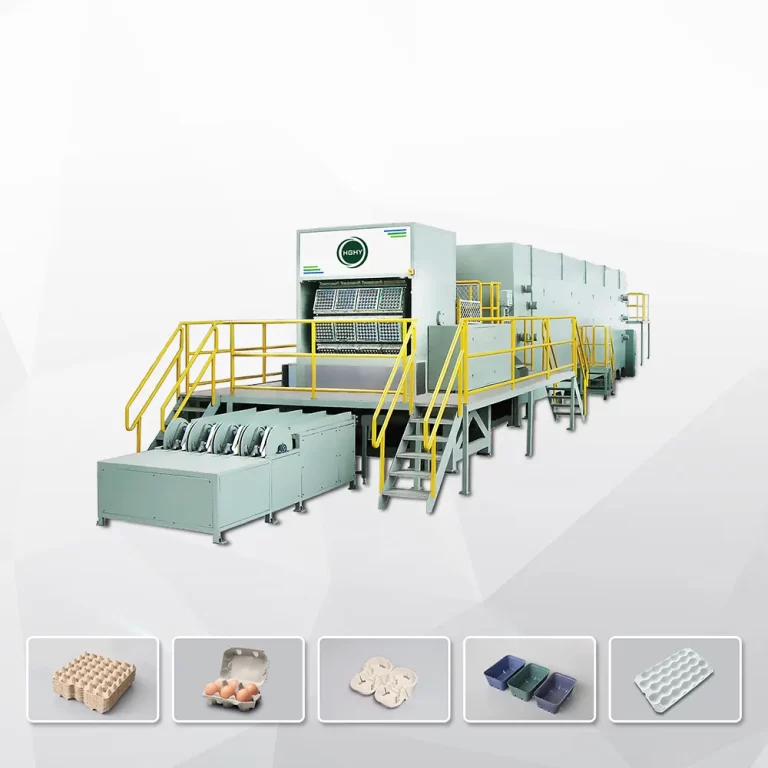 HGHY Egg Tray Making Machine — rotary forming with a 6-layer drying line, available in 2,000 / 4,000 / 6,000 pcs/hour configurations.
View Product Details →
HGHY Egg Tray Making Machine — rotary forming with a 6-layer drying line, available in 2,000 / 4,000 / 6,000 pcs/hour configurations.
View Product Details →
From waste paper to finished tray: the process, step by step
The chemistry behind molded pulp isn't complicated, but how tightly each stage is controlled determines the final strength, finish, and energy bill.
Step one: pulping. Recovered paper — old newspapers, magazines, cardboard boxes — gets pulverized, screened, and blended with additives to produce pulp at the concentration needed for forming. The raw material bar here is genuinely low: most lines run on a fairly dilute pulp mix, which is one reason factories often source scrap from nearby paper recyclers or printing plants rather than buying virgin pulp.
Step two: vacuum forming. This is the heart of the process. A vacuum pump system pulls the pulp tightly onto a rotating mold to shape it, drawing off part of the moisture at the same time; the extracted water gets stored in a tank for reuse. An air compressor system then helps separate the formed wet tray from the mold, a conveyor carries it off to drying, and a cleaning unit resets the mold for the next cycle. This stage behaves a bit like 3D printing — the density and dwell time of the suction holes determine whether every cell in the tray ends up with even wall thickness, which is exactly why two lines both marketed as "fully automatic" can produce trays with noticeably different strength and finish.
Step three: dewatering. Right after demolding, the wet tray still holds a lot of water. Mechanical pressing squeezes out most of that moisture before the tray heads into the dryer — a step outsiders tend to overlook, even though skipping it just shifts the energy cost downstream onto the drying tunnel.
Step four: thermal drying. This is the stage that sets your real production ceiling, and your running costs. Natural air drying depends heavily on local weather, humidity, and wind, and typically takes 4 to 7 hours; switching to a brick drying line or a metal drying line cuts that down to 10 to 25 minutes. For any plant running several thousand units a day, open-air drying simply isn't viable — it eats too much floor space and can't keep pace with order volume, which is why multi-layer metal drying tunnels have largely displaced outdoor drying yards in recent years.
Step five: counting and packing. Dried trays pass through an automatic counter and packer that compresses and bundles them to a set count, which saves storage and shipping space and cuts down on breakage in transit.
Choosing equipment: capacity, automation level, and what they actually cost you
This is where most buyers focus the most attention — and where spec sheets are easiest to misread. Two lines can both be labeled "fully automatic" while sitting on completely different scales of investment, floor space, and labor.
Rough capacity tiers commonly seen in the market:
- Manual / small-scale lines: typically 1,000–2,500 pieces/hour. A common 4×4 egg tray machine runs at roughly 2,200–2,500 pieces/hour on about 3 kW of power — a reasonable entry point for limited budgets, though labor dependency stays high.
- Semi-automatic rotary lines: an 8-face rotary egg tray machine can hit 3,500–4,500 pieces/hour with 40 molds and about 4 kW of power. Drying on this tier often still leans on manual intervention or open-air drying.
- Fully automatic mid-to-large lines: a 5×12 model can reach 5,000–6,000 eggs/hour with a high degree of automation, sharply cutting manual handling from raw material to finished product. These lines usually come with multi-layer metal drying and automatic packing already built in, and they're the current default for mid-sized poultry packaging operations.
- Large-scale lines: an 8×8 configuration with 64 molds total can reach 9,000–10,000 pieces/hour, currently the largest single-line capacity commonly available — suited to large egg processing groups or export-oriented factories.
One thing worth correcting: the real difference between manual, semi-automatic, and fully automatic lines isn't just throughput — it's mainly the drying method and the packing method. So the more useful question to ask a supplier isn't "is this fully automatic," it's: is drying done by open air, brick tunnel, or multi-layer metal line — and is the packing stage automatically counted and compressed? Those two answers tell you far more about real labor cost and output consistency than the "fully automatic" label does.
Heat source for drying is also worth planning for in advance. Drying lines commonly run on natural gas, diesel, gasoline, biomass pellets, or steam from heat-conducting oil — and which one makes sense depends heavily on local energy pricing and environmental regulation. That's a big part of why the same line model can be quoted very differently between, say, eastern China and Southeast Asia: the gap is rarely in the core machine, it's in the supporting energy system.
Why the industry is upgrading equipment faster right now
Looking at specs alone, molded pulp machinery hasn't seen a dramatic technical leap in recent years. What's actually pushing plants to replace lines is happening on the demand side.
First, regulation is translating directly into purchasing decisions. More than 140 countries have introduced legislation regulating or banning single-use plastics, according to the United Nations Environment Programme, and that's materially accelerating demand for alternatives like molded fiber. This isn't an abstract policy shift — it's changing procurement standards at retailers and food companies, turning molded pulp from an optional choice into the default for a growing number of product categories.
Second, the underlying end-market is simply getting bigger. The World Health Organization projects that global urban population will reach 68% of the total by 2050, with food packaging demand rising in step with population growth and urbanization, and according to the Food and Agriculture Organization, Asia Pacific accounts for more than half of global food production and consumption — a substantial and durable base of demand for food-safe packaging like molded pulp egg trays. That also explains the recent pickup in equipment purchases across Southeast and South Asia: it's not just capacity shifting from elsewhere, it's local consumption itself growing.
On market size, different research firms don't fully agree on the exact number — itself a sign of how fast this space is moving — but the direction is consistent. The global molded fiber pulp packaging market is projected to grow from USD 10.7 billion in 2025 to USD 20.6 billion by 2035, a CAGR of roughly 6.8%, with food and beverage remaining the largest end-use segment, expected to hold about 50% share in 2025, driven heavily by trays for eggs, fruit, wine, and ready-to-eat meals. Zooming into egg packaging specifically, the global molded fiber egg packaging market is forecast to grow at a CAGR of around 5.6% between 2025 and 2031, reaching roughly USD 1.076 billion by 2031.
The raw material side has shifted too. Recycled pulp is expected to account for about 88.7% of the market by source in 2025, on the back of cost advantages, easy availability, and a smaller carbon footprint versus virgin pulp. The practical takeaway for a plant: most poultry-related molded fiber products don't need expensive virgin wood pulp at all — locally sourced waste cardboard and old newspaper can meet the strength requirements for the bulk of orders, which is part of why this industry has more raw-material flexibility than most other packaging categories.
What to actually verify before you buy
After all the specs and market numbers, a few details get overlooked far too often during procurement — and they're the ones that tend to cause real problems later.
How many molds actually come standard, and how compatible are they. The same main unit can switch between egg trays, egg cartons, or chick boxes just by swapping the mold plate, but molds are consumable — wear degrades forming precision over time. Ask suppliers directly about expected mold lifespan and replacement cost per set, rather than judging the deal purely on the price of the main machine.
Whether the drying system genuinely matches the stated capacity. As noted, open-air drying and a metal drying tunnel can differ by more than tenfold in cycle time, yet some smaller suppliers quote a stripped-down drying setup to keep the headline price competitive. Plants often discover only after startup that drying can't keep pace with forming, leaving the whole line bottlenecked in the middle — a problem that shows up especially often with secondhand or refurbished equipment.
Whether local energy infrastructure actually supports the line's designed heat source. If natural gas supply is inconsistent locally but the equipment is designed around gas-fired drying, retrofitting later tends to cost more — in both money and downtime — than expected. This is worth settling with the supplier at the selection stage, not after the equipment has already arrived.
After-sales support and parts turnaround. Core wear parts on molded pulp equipment — molds, seals, vacuum pump components — need replacing fairly often. For cross-border purchases especially, confirm where spare parts are stocked and how fast they can be shipped; downtime waiting on parts can easily cost more than the equipment's own depreciation.
Overall, the process engineering behind a molded pulp poultry packaging line is mature and well understood at this point. What actually determines return on investment usually isn't the "automatic" label on the spec sheet — it's the real efficiency of the drying system, how long the molds last, and whether the supplier's after-sales support holds up. With both policy and market demand pushing in the same direction, it's worth working backward from your actual order volume and local energy situation rather than chasing the biggest capacity number on the page.