
Understanding the entire process of egg tray production is essential for optimizing efficiency, ensuring high product quality, and reducing costs. The pulp egg tray production line is a sophisticated system that converts waste paper into eco-friendly egg trays through a series of well-defined steps. From the raw material (waste paper) to the final molded and packaged trays, each stage plays a critical role in delivering high-quality products.
In this article, we will break down the production process step-by-step: from pulping waste paper to molding, drying, hot pressing, and finally, packaging the trays. We will also connect the process back to “The Complete Guide to Pulp Egg Tray & Egg Box Production Lines”, providing a comprehensive overview of the critical production steps involved.
Pulping: Transforming Waste Paper into Pulp
Step 1: Pulping Process
The first stage in the pulp egg tray production line begins with the pulping process. The key raw material for pulp production is waste paper, such as old newspapers, cardboard, or other paper-based materials. These materials are collected, cleaned, and shredded into smaller pieces before being mixed with water to form a slurry of pulp.
Equipment Used: Pulping machine, hydraulic pulper, and pulp mixer.
Process Details: The paper waste is combined with water in the hydraulic pulper. The mixture is agitated and refined to break down the paper fibers. The consistency of the pulp is critical to the molding process, and any imbalance can lead to defects in the final egg trays.
Molding: Shaping the Egg Trays
Step 2: Molding Process
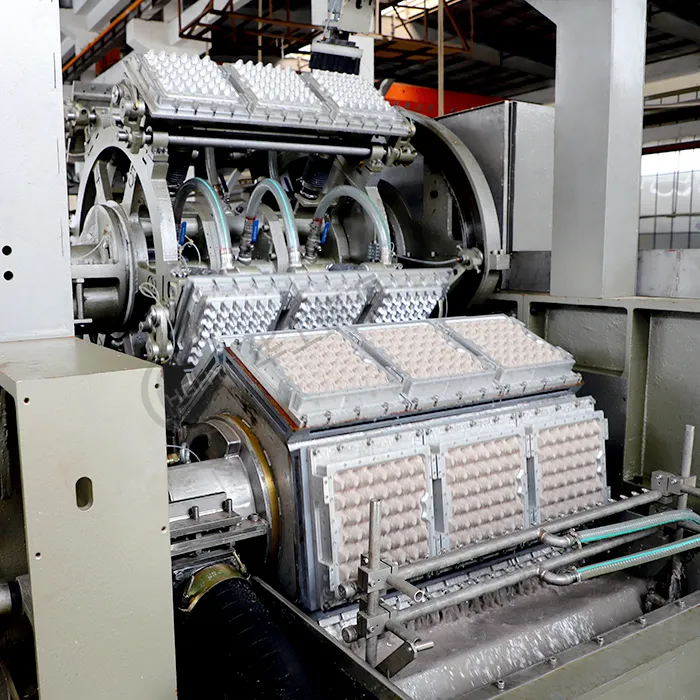
Once the pulp is prepared, it is transferred to the molding machine. The pulp slurry is spread onto a mold to form the shape of the egg trays. The pulp is vacuum-suctioned into the mold cavity, where excess water is removed, and the pulp takes the shape of the desired egg tray design.
Equipment Used: Molding machine (Rotary or Reciprocating type).
Process Details: The pulp slurry is poured into the mold, and a vacuum system is employed to suck the slurry into the mold. The molds are usually designed to fit the specific tray size (e.g., for 6, 12, or 30 eggs). The vacuum system ensures that the pulp fills every cavity of the mold, ensuring uniform thickness and shape.
Drying: Ensuring Proper Strength and Durability
Step 3: Drying Process
After the pulp has been molded into egg trays, the trays need to be dried to remove excess moisture and harden the pulp into its final form. This is a critical step, as insufficient drying can lead to weak and fragile trays.
Equipment Used: Drying oven, tunnel dryer, or rotary dryer.
Process Details: The molded egg trays are placed in a drying system, where they are exposed to hot air or steam to evaporate the moisture content. The trays are typically passed through a drying tunnel where air circulation ensures even drying, or they are placed in a rotary dryer that heats the trays from all sides.
Hot Pressing: Enhancing Tray Strength and Structure
Step 4: Hot Pressing Process
For added strength and to enhance the structure of the egg trays, hot pressing is often used. The trays are pressed under heat and pressure, which helps to compact the fibers and improve the trays’ structural integrity. This step ensures that the trays can withstand the pressure and weight of the eggs during transportation and handling.
Equipment Used: Hot press machine.
Process Details: The dried egg trays are placed into a hot press, where they are subjected to high temperatures and pressure for a set duration. The heat softens the fibers, while the pressure compacts them, resulting in stronger, more durable egg trays.
Packaging: Ready for Distribution
Step 5: Packaging Process
Once the egg trays are formed, dried, and hot-pressed, they are ready to be packaged for shipment. The packaging process ensures that the trays are protected and easily transportable to customers.
Equipment Used: Automatic packaging machine, conveyor system.
Process Details: The finished trays are stacked and passed through an automatic packaging machine. The trays are wrapped in protective plastic or paper to prevent damage during shipping. The trays are then sorted, stacked, and labeled for easy identification and distribution.
Conclusion
The pulp egg tray production line is a highly efficient system that transforms waste paper into eco-friendly, durable egg trays through a systematic process of pulping, molding, drying, hot pressing, and packaging. Each step is crucial to ensuring that the final product meets the required quality standards, while minimizing waste and energy consumption.
By following the steps outlined in this article, businesses can optimize their egg tray production line and ensure high-quality, consistent products. This subtopic connects directly to “The Complete Guide to Pulp Egg Tray & Egg Box Production Lines”, providing a more detailed look at the individual stages involved in transforming waste paper into finished egg trays.